
Low Back Pain: It’s Not Always Coming From Your Spine


Musculoskeletal & Sports Medicine


Low Back Pain: It's Not Always Coming From Your Spine
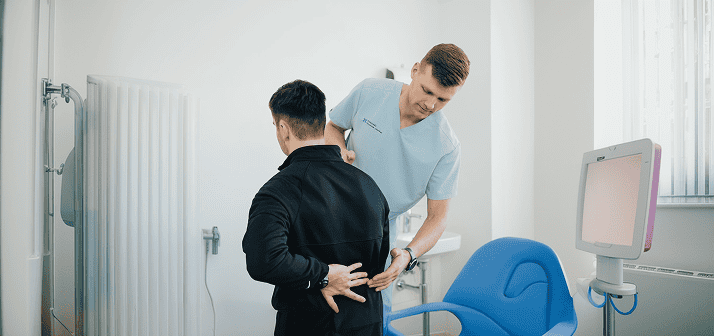
Most back pain gets blamed on the spine. Sometimes the spine is innocent — and the real cause is sitting quietly somewhere else, waiting to be found late.
How common is this, really?
Common enough that it’s the single biggest cause of disability on earth.
Around 60–80% of people will have low back pain at some point. Globally it affects over 600 million people, projected to reach 843 million by 2050. It has been the world’s leading cause of years lived with disability since 1990.
And roughly 70% of the disability falls on working-age adults — people in their 20s to 60s, in the middle of their earning years.
So if your back has gone on you: you are extremely normal. That’s the good news and it’s also the problem, because “extremely normal” is exactly the assumption that lets the unusual cases slip through
What are the actual warning signs?
Worth knowing, and worth not over-reading. The vast majority of back pain has none of these.
Numbness in the “saddle” area — the groin, inner thighs, or around the back passage — or new difficulty controlling your bladder or bowels. Emergency, same hour. This can mean nerves at the base of the spine are being compressed, and the window to prevent permanent damage is short.
Progressive weakness in a leg or foot — a foot that catches on kerbs, a leg that gives way.
Fever with back pain, or feeling systemically unwell.
Unexplained weight loss, or a past history of cancer.
Pain that’s clearly worse at night and wakes you, or that doesn’t ease at all with rest.
Significant injury — a fall, an accident — particularly if you have osteoporosis or take long-term steroids.
Sudden severe pain in someone over 60, especially a smoker with high blood pressure.
Age under 20 or over 55 at first onset.
If none of these apply, the odds are strongly in your favour — and, importantly, so is the case for not rushing to a scanner.
Do I need an X-ray or MRI?
Usually not, and this is one of the most robustly evidenced positions in medicine.
Guidelines consistently recommend against imaging for back pain in the absence of red flags. Imaging within the first six weeks does not improve outcomes — it just adds cost, radiation and delay. The American College of Physicians goes further, advising against routine imaging in non-specific back pain even beyond six weeks.
Here’s why, and it’s the fact that changes how people think about their own scan.
Scans of people with no back pain at all show “abnormalities” everywhere:
| Finding on MRI in people with no back pain | Age 20 | Age 80 |
|---|---|---|
| Disc degeneration | 37% | 96% |
| Disc Bulge | 30% | 84% |
Disc bulges alone are present in 44% of asymptomatic people under 40, 60% aged 40–59, and 75% over 60. Degeneration, bulging and facet joint changes have been documented in close to 90% of people over 60 who have no symptoms at all. It is, as much as grey hair, a feature of having been alive for a while.
So a scan showing “degenerative disc disease” and “L4/5 disc bulge” hasn’t necessarily found your problem. It’s found something that’s probably also true of the person sitting next to you, who feels fine.
And it isn’t harmless to look. People shown their scan findings tend to do worse — more worry, less movement, more treatment, and no better outcomes. You cannot un-see the word “degeneration” on a report.
When imaging genuinely earns its place: red flags present, symptoms not settling over a reasonable period, or planning a specific procedure.
So what actually treats it?
Movement, and time, and knowing what you’re dealing with.
For most back pain the outlook is good: it settles. What matters is not making it worse in the meantime — and the classic way to make it worse is to lie down and wait.
Physiotherapy is the mainstay, and it works through several channels at once. It rebuilds the deep trunk muscles that stabilise the spine, restores movement in stiff segments, corrects the guarding and bracing patterns that develop after a painful episode, and — this is underrated — it retrains the nervous system’s threat response. A back that has hurt learns to expect hurting, and that expectation is itself part of the pain.
Three things worth doing while you sort it out:
- Keep moving. Walking is genuinely treatment. Bed rest beyond a day or two makes back pain worse, not better.
- Hip hinge, don’t spine bend. Push your hips back and keep your chest open when you pick something up. Most people bend at the waist purely out of habit.
- Get the programme built properly. The exercises that help are specific to what’s actually going on — which segments are stiff, which muscles have switched off, how you’re guarding. A generic exercise sheet off the internet is not the same thing, and doing the wrong exercises confidently is how people conclude that “movement makes it worse”. This is what physiotherapists are for.
And be honest about the load. Deconditioning, weight, stress, poor sleep and a job spent in one position all feed back pain. None of that is fixed by a scan.
Our Clinical Insight
Nearly everyone experiences back pain at some point in life. While the spine is often blamed, some of the most important causes actually originate elsewhere in the body. Recognising these conditions early can prevent delayed diagnosis and unnecessary investigations.
Two mistakes, pulling in opposite directions, and both common.
The first is scanning too readily — finding the normal changes of ageing, calling them the cause, and setting someone up for years of believing their back is broken.
The second is the opposite: assuming every back is a muscle problem, and missing the kidney, the aorta, the infection. A urine test costs almost nothing. A hand on the abdomen costs nothing at all.
Getting this right isn’t about doing more tests. It’s about asking better questions first — then testing what the answers point to.
If it's not my spine, what else could it be?
This is the part most people have never been told.
The back is the wall. Behind it sit the kidneys, the aorta, the pancreas, the gallbladder and the uterus. Any of them can send pain to the back — and a back that hurts because of an organ behaves differently from a back that hurts because of a joint or a muscle.
Kidney stones. Classic pattern: pain that comes in waves, often severe, starting in the flank and travelling round to the groin. People pace and can’t get comfortable — which is telling, because mechanical back pain usually has some position that helps. Blood in the urine is common, and often invisible until tested.
Kidney infection. Fever, feeling genuinely unwell, sometimes burning on urination — with a one-sided ache over the flank. Easy to mistake for a muscle strain in someone who happens to be run down. A urine test settles it in minutes, which is why it’s worth doing rather than assuming.
An abdominal aortic aneurysm. The one that matters most. A swelling in the body’s main artery can cause back or flank pain, and it is regularly mistaken for something benign — one emergency department series found roughly 18% of symptomatic aneurysms were initially diagnosed as kidney stones. The catch is cruel: blood in the urine can appear in both, which pushes doctors toward the wrong answer. Anyone over 60, especially a current or former smoker with high blood pressure, who develops new severe back or abdominal pain, deserves this to be actively considered rather than assumed away.
Also worth naming: gallbladder and pancreas problems (pain boring through to the mid-back), gynaecological causes including endometriosis, shingles before the rash appears, and — uncommonly but importantly — infection or cancer in the spine itself.
A simple discriminator: mechanical back pain usually changes with position and movement. Pain from an organ often doesn’t care what position you’re in. If nothing you do makes any difference, that’s information.
Numbness around the groin or back passage, or new difficulty controlling your bladder or bowels? Go to an emergency department now — do not use this tool. These can mean nerves at the base of the spine are being compressed, and the window to prevent permanent damage is short. Contact the clinic
🚩 Does this back pain need urgent attention?
Most back pain has none of these features. The point of running through them is to be sure — because the few that matter, matter a great deal.
This tool doesn’t diagnose anything and doesn’t replace being examined. If you’re worried, act on that.
If your back isn't settling
A proper back consultation examines your spine, your hips, your abdomen and your neurological function, actively considers the non-spinal causes, and gives you a plan — not a scan referral by default.
Cresta Medical · 10 Chai Chee Road, #01-01, Singapore 467010
Numbness around the groin, or new bladder or bowel problems with back pain — go to an emergency department now.
Make your health a priority
Schedule an in-clinic appointment, or speak with Dr Alexis Wong and our care team online — whichever works best for you.